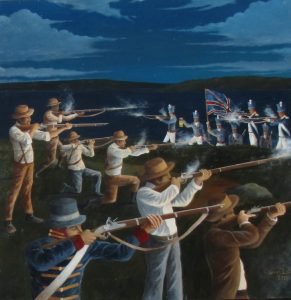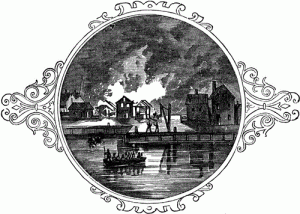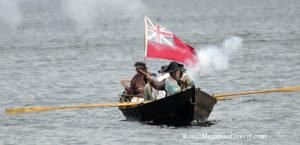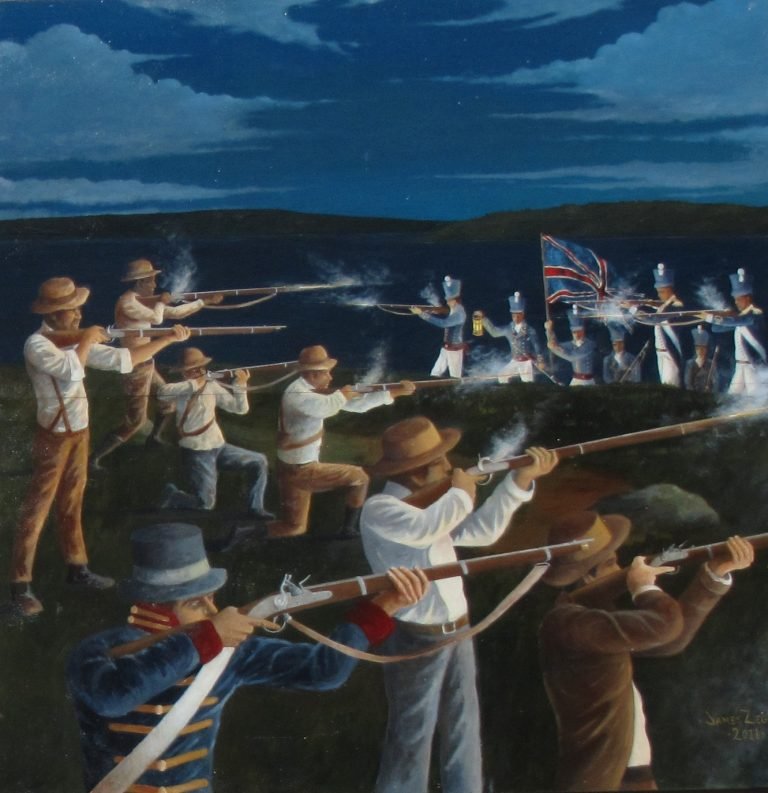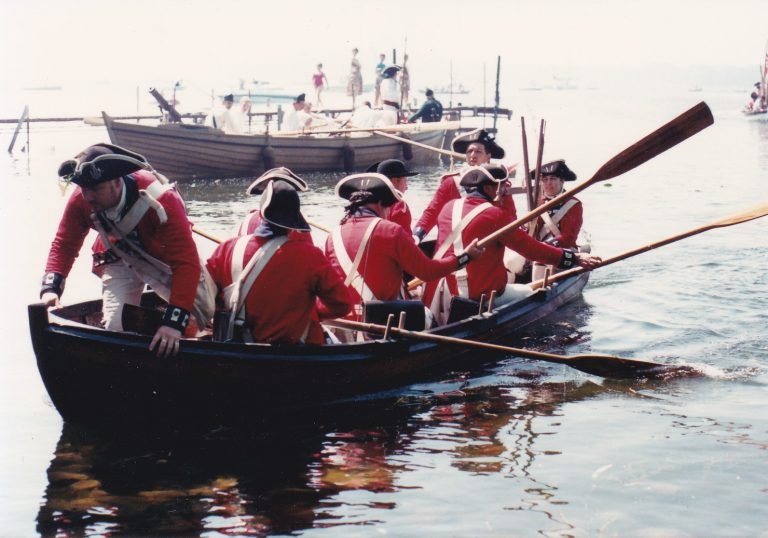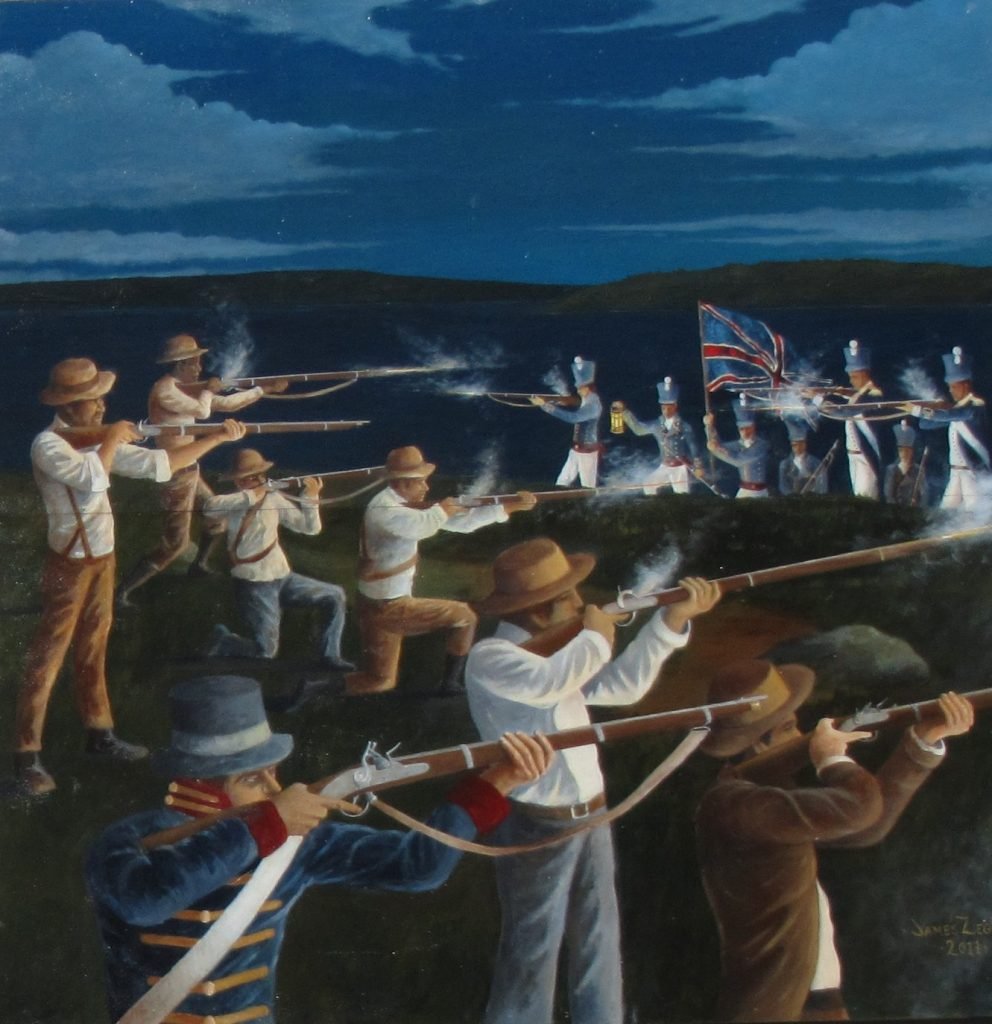
On the night of June 19, 1813, during the War of 1812, a British landing party from ships on Lake Ontario met settlers and militia in the dark at Sodus Point. The next morning the British burned the village, sparing a single house. This page gathers everything on the site about it: the accounts, the people and places, and the plaques, mural and reenactment that remember it.
Where the accounts differ
The pages here draw on accounts written from 1813 to the 1980s, and they don’t always agree:
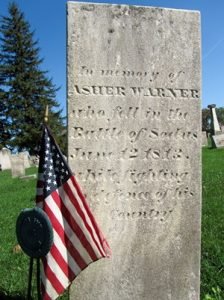
- The date. Most accounts, beginning with the Ontario Messenger of June 29, 1813, put the attack on Saturday, June 19, 1813. Asher Warner’s tombstone, some newspapers of the time and a 1905 account (quoted in the main story) say June 12. “The Men” notes that affidavits filed for compensation and other evidence establish the 19th.
- How many British landed. One hundred men, says the Ontario Messenger, and so does the Seaway Trail panel. About 100–150, says “Lead up to the Battle”; about 200 marines, says the 1812 Peace Garden panel; and a force “supposed to be 300 or more”, says Lewis H. Clark’s 1883 history.
- How many defended the village. About forty men under Captain E. Hull, in the Ontario Messenger. About 50, on the Battle of Sodus Point mural. About 60, in “Lead up to the Battle” and on the Peace Garden panel. “Some 50 or 60 men” with Captain Norton, in an 1876 account quoted in “The Men”.
- The losses. The Ontario Messenger gives one American killed and three wounded, and three British killed and seven wounded. Clark has Asher Warner and Charles Terry mortally wounded and several others hit, and two or more British killed; a note in the main story names two British privates who died of their wounds.
- Prisoners. Clark says the British carried off three prisoners that night: Christopher Britton, Harry Skinner and Gilbert Saulter. The 1905 account says two, Britton and Harvey, captured in a skirmish at the landing the next day.
- Why the British turned back. In Clark’s telling, neither side knew the other’s strength in the dark, and both withdrew. In the 1905 account, the Americans fell back behind a breastwork of barrels of stores in the ravine, and the British commander, seeing the barrel heads by torchlight, seems to have taken them for a battery.