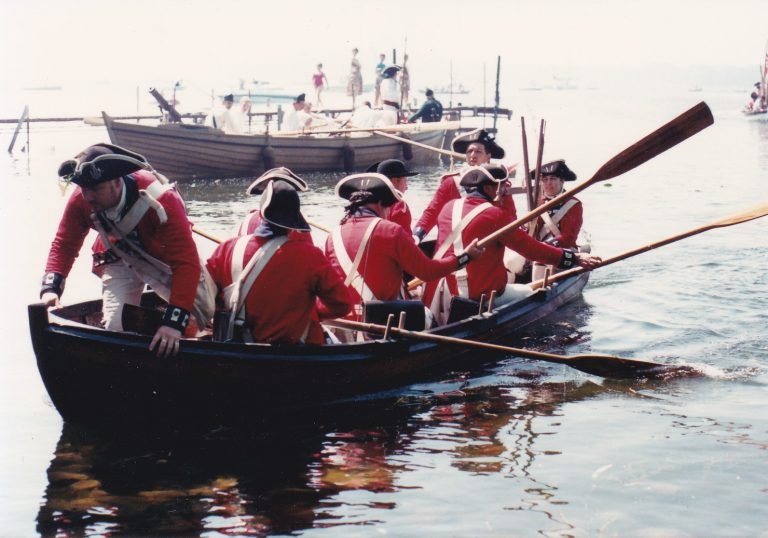
Sodus Point POWS running to the soccer field. Photo courtesy of Debra Werfelman, From the book “World War II Prisioner of War Camps in Wayne County, New York and Their Prisoners” by Annette T. Harris
In the last days of 2018, I was contacted by Andreas Suchi. Andreas was researching the story of his Grandfather who had been a German POW during World War 2 at our Sodus Point POW camp. Andreas had the diary of his Grandfather that contained information from the time of his capture in Normandy in July 1944 through his time spent in the Sodus Point POW camp. After helping Andreas obtain some additional information, he told me he was translating the diary (which was written in old German) into English and would I be interested in having the translated diary for our website? Uh…..YES!!!!!!
He has finished the translation of the first part of the diary (10 pages) which starts from his Grandfather’s time and capture in Normandy (June/July 1944) until November 1944 where he is in the Fort Niagara POW camp.
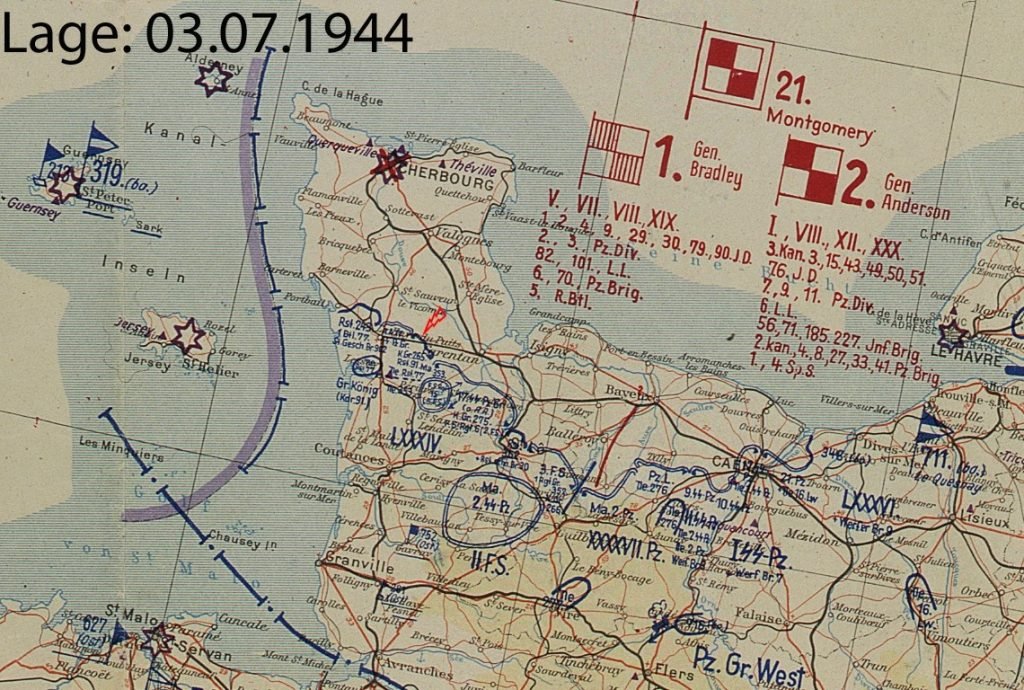
Andreas Suchi has done research on where his Grandfather was captured based on German War records, The red X on the map indicates the location.
The second part will deal with his time in the Sodus Point POW camp.
Here is the first part: Diary of Walter Meyer POW Part 1
Diary of Walter Meyer
Translated by Andreas Suchi
America, November 19, 1944.
A prisoner camp in America. Clean barracks surrounded by barbed wire. The gates locked and the watchtowers at the corners occupied by guards. … <censored> floodlights and every 5m along the fence … < censored>
Today is November 19, 1944. I am sitting in the warm dining room, which serves as the common room during our free time. Outside the storm howls and whips the waves of Lake Ontario.
My notes have been lost and so I want to try to capture some things from memory on paper. My thoughts wander back:
Capture in France
It is June 1944. In Brittany (France), in the area of Quimper lay the II. Infantry Regiment 894. 894. I was a radio operator. I spent wonderful days in Fouesnant and Benodet, drinking some glasses of wine and sitting in the beautiful soldiers' home in Benodet, at the mouth of the Odet into the Atlantic.
Now for us the war should also begin, which was not the case yet here in France, apart from small partisan attacks. At the end of June, the entire battalion was suddenly mobilized to Normandy. Bicycles were provided, the backpacks packed on a truck, equipped only with the most necessary, the trip started. Actually, I never really felt good in France … <censored> … and so I was partly happy to get out of Brittany. 80 km and more we cycled during the night to sleep in a shed on straw or on a hayloft during the day. The ride was very hard for me and I was glad that my bike broke down and I was able to drive the last few days in the truck.
June 29, 1944 was the day when I received my so-called “baptism of fire”. The companies were already ahead with the bicycles and on this day, we wanted to cover the last stretch to the operational location by truck early in the morning. It was a rough drive to the destination but when we arrived at a Engineer unit around noontime, we found out that we had lost our way. Sergeant R., ordered corporal E. and I to walk back to the battalion command post and arrange for the truck to be picked up by dispatch riders. We went on our way. Abandoned villages we left behind us, the houses cleared out and all household messed up. In the pastures cows grazed, some of which roared terribly because they had not been milked for days. Small livestock and even pigs roamed freely. Dead, bloated cattle were not a nice sight. Soon we reached an artillery position, where we got more information about the location of our battalion. With a few remaining company members of our battalion that we met, we made our way to L., where our companies should be. The way there should not be that easy for us. We had just reached a crossroads, of which some artillery comrades had warned us, when we were suddenly surprised by American artillery fire, who were able to see
the road at this point. I have probably never lain on the ground as quick as this time and I ducked my head down in the sand behind a small embankment on the road; the artillery hammered incessantly. The grenades exploded on the street and the splinters flew around us. Unfortunately, the intersection was also attacked by some fighter planes who dropped their bombs and covered the road with their machine guns flying over at low altitude. I could not duck in the ground deep enough. I was completely helpless because any move would have revealed my position. I cannot say what I endured. Internally I cursed that I could get a bullet here and I had not yet reached my operational location. But it went well for all of us. The airplanes retreated, the artillery stopped firing and unharmed we went running a few hundred meters to a farm, where we finally recovered. We realized that we had lain in the dirt for roughly two hours. That was my baptism of fire, which I will probably never forget.
We then made our way past the main hospital area and after one hour we reached the battalion command post, where the companies were accommodated. Here we could grab some food. But that shouldn’t have been everything this day. Towards the evening we got artillery fire again and we had the first casualties, who were soon transported away by the corpsmen. Later in the evening, the battalion was brought forward as fighting unit M …, where we replaced another battalion. During this evening we radio operators stayed at the battalion command post, where we made ourselves comfortable in a foxhole. The grenades howled over our heads, it was not quiet during the whole night. However, I still slept, although it was a bit unwonted. On the next day – June 30, 1944 – we radio operators were instructed to a different location. With my comrade Thilo Ruwe from Bremen, we came to the battalion command post of the 5th company. We were lucky. We were assigned a finished foxhole, which we only needed to upgrade a bit. As good as possible, we set up with our radio boxes, built up and connected with the battalion command post. The reception was good. With lieutenant Schröder, the company commander of the 5th company, we got along very well, and the buddies of the company detail we knew already, they were ok. The day passed with the establishment of our hole. In the evening, I joined the others to get some food, and I realized that as radio operators we were not yet registered. So I only got bread and hot food for both of us. It was quite good that I had stocked up myself well with butter, so I got along quite well. The way to the field kitchen, which only came through in the evening, was quite difficult. It went through ravines and muddy paths and the shells kept howling over our heads. When we returned to the battalion command post with the cookware and water bottles, food and coffee were cold. So the days passed without any special events. We did not get out of the clothes and with the washing, it was a matter on its own. For hours we then had to lie in the foxhole, because the American artillery fired constantly. During the day one could move only well covered, because the U.v.D (reconnaissance planes) of the Americans constantly circled slowly and silently in the air. A small French village behind us went up in bright flames and the road was constantly covered with artillery, so that we had to use farm tracks in the evening to get to the kitchen. But I can say that despite the cannon thunder, etc., I was always
able to sleep well in my foxhole, wrapped in a blanket. Somehow you get used to everything.
On the morning of July 3, 1944, we were awakened by a particularly violent artillery and grenade launcher fire. It cracked and thundered incessantly. I ventured out of our hole for a short time; it was raining heavily. At dawn, the firing of the heavy weapons broke out, and now you could hear rifle and MG fire nearby, did the Americans attack? We tried to establish a radio link, but got no connection. Messengers went and came and it was quite restless. The fire got stronger, when suddenly we had to retreat. Quickly we put the steel helmet on, grabbed ammunition and karabiners, our gas masks we did not take in the rush, and out of the foxhole we went. We quickly pulled off a hand grenade and our equipment and private things blew up into the air. Outside we heard shouting and went back with the lieutenant Schröder. We ran crisscross. It was not long before we were wet to the skin. The water squeaked in our shoes, trousers and shirts were soiled by the mud and torn by thorns. The hands were bloody and completely scratched. But nothing could stop us. I could’nt understand various actions of our lieutenant, but we were not supposed to think.
Permanently scattered people from the company came to us, so we were already a big group. We went back to the regiment command post. Here we got new ammunition. Again we went forward some 100m, where we went in position behind a wall. Behind the wall, I suddenly heard strange sounds. When I looked over the wall, I saw some American steel helmets. So we were 2 to 3 meters opposite, as we were instructed "all retreat to batallion command post". Also this action was not understandable to me. We left a well-protected position without firing one round. Again we went through thorn hedges up and down ramparts. It was still raining and it was pretty cold in the wet clothes. The battalion command post was a wild mess. The artillery intensified again. Before and behind us, the grenades exploded. The battalion commander in an dirty uniform, without a cap, armed only with a K.P, ordered retreat to regiment command post. Back again, always one after another. The artillery kept on firing and constantly we could hear shouting from the ones that were struck. Everything went haywire. You cannot describe that in words. We reached the country road, a group of 50 – 80 men, the rest of the II./894. Here I was separated from my buddy Thilo Ruwe. Later I heard from seargent W., whom I met in a prison camp, that he, too, had been captured. In a group of 42 men I was (11) deployed in another combat group in another company in the late afternoon. Again we went forward. My clothes were now dried, but I was missing a blanket, cookware, in fact everything you need. The new location was quiet. Now a hole was shoveled to have a small shelter for the night. Some had food and now we were able to restore ourselves, because since the morning I had not eaten anything. That night we slept in turns.
July 4, 1944 began. The night was quiet. The sun rose and it was a nice warm day. We lay on a small hill on the edge of a cornfield, with two men in a hole. One watched and the other slept. Every now and then grenades howled over our heads and drowned in the cornfield. During the morning, the Americans attacked on the left wing and also we were attacked by machine gun and rifle fire. The fire was returned
by us vehemently. A breakthrough did not succeed in our location. But we had an unfavorable position, because (12) behind our backs bullets were constantly whistling. During the morning the fire ebbed away again, but the artillery covered us even more. From time to time we got a machine gun volley, which we answered twice. Meanwhile we had a casualty on our side. The artillery fire was getting stronger and the grenades died in alarming proximity. Suddenly we were covered with grenade launcher fire so that we could not get out of our hole. After a short break in the fire, the fire was returned by us vigorously. I had my last 5 cartridges in the barrel and there was no new ammunition coming forward. Again the heavy grenade launchers set in and the splinters just flew around us. Cover and cover again and again. Suddenly the Americans fired smoke bombs, so that it was no longer possible for us to see the next man, who was about ten meters away. During the break that followed there was a big surprise for us 8 men. We just wanted to breath some fresh air after the smoke had cleared a bit, when we were suddenly surrounded by a group of 20 to 30 Americans. (13) Since resistance in this overpower situation was useless, our machine gun had no more ammunition, there was only one thing for us, surrender. With raised hands we (7 men, 1 sergeant) had to make our way into captivity. It was about 3 pm. Only what I had on went with me, because I had to leave behind all my things during the retreat. Torn and scratched, unwashed, unshaven and dirty it started. In the first hours I did not come to the consideration. I still could not make friends with the idea of being a prisoner. But the silence was good, the war was over. On a truck we went to the first transit camp, where we were interrogated and searched for the first time. From the beginning, we were treated decently by the Americans. Towards the evening we continued to a larger camp.
There was nothing to eat on this day and the first night we had to spend in the open air without a blanket or coat. Of course, sleep was out of question, it was very cold, especially since we were near the sea (St. Merglies). I had a slight wound on my right arm, which festered violently. The night was everything (14) else than beautiful. I was glad when it was dawning. We were able to warm ourselves with big fires.
July 5th, 1944: Today we got the first food, namely the American field ration C. This consists of 2 small cans.
The first can: beans, tomatoes cooked with meat.
The second can: 5 biscuits, 5 candy, 2 pcs. sugar, 1 small can with coffee, 3 cigarettes. At big campfires we brewed a coffee and could warm ourselves again. Now again there were examinations and interrogations. All things had already been taken from me. I was allowed to keep 2 handkerchiefs, 1 pencil, 1 comb and my glasses. By the way, we looked like pigs. The uniform torn and dirty, not washed and shaved. It was not nice, but we could do nothing about it. I met several comrades, but nobody anymore form the radio squadron.
In the late afternoon we were called to assemble again. Before that, I had my arm wound treated in the hospital, with the doctor removing a shrapnel. Then on foot we went 6 km (15) to St. Merglies, the landing place of the Americans. Here it was very
busy. Steamer came and went and a lot of work was done. The streets were full of trucks. They went back and forth. Again we had to spend a night outdoors, right by the water. Like the herrings, we lay to keep a bit warm.
Journey to England and America
On July 6, 1944 we started the journey to England in a small freighter. It was a weird feeling, would we safely pass the English channel? In a freighter, which had big gates at the rear, we were shipped. Everyone got a blanket and then we could lie on the iron plates of the ship. On the ship a lively trading with the crew began. For my last 100 Francs I bought 20 cigarettes. The first American cigarettes, that did not taste at first, but they were better than the black French ones. From the channel we did not see anything during the whole crossing. In the morning of July 7, 1944 we arrived in England and were disembarked at dawn in Portland. In groups of 50 each we came to a small transit camp. The first (16) short march in England. In the camp we got hot water and 2 cans (field ration C). Quickly a coffee was brewed and we ate. Here we had the first washing opportunity. Somebody had soap, somebody else had razors, a broken mirror was still available and so we could at least make ourselves a little human and clean the uniform of the biggest dirt.
At about 8 o'clock we were loaded into a nicely heated passenger train and the first trip in England started. Excited, I looked out of the window to see a good deal of England, but soon I fell asleep, and I woke up at about 3 clock when we were at the destination. In Bristol we were unloaded and on foot we went through the city to a large transit camp. Here it started with investigations, searches, delousing, personnel recording. Neatly I felt after the short shower. It would have been nice if I had fresh laundry, because the underwear was torn and dirty. The treatment was good. In barracks, provided with 2 blankets, we slept well. The rest was good for me after the exciting days. Here I also got to know the American bread, which resembles our white bread. (17) At first I did not like it. On July 8, 1944 interrogations were followed by interrogations. During this, I realized how well the Americans were informed of all the operations in Normandy. We now got food (coffee, white bread, meat, potatoes, vegetables) three times a day. It was not much, but we were prisoners and had to be content. After the interrogations on July 9, 1944 I came in a large corrugated iron shed (formerly airplane shed), where we lay with 180 men in double beds. During the day we were busy with small jobs in the warehouse. On July 10, 1944 I had another chance to shave. Above all, cigarettes were missing, unfortunately we did not get them. It was not a nice time. But the good mood did not leave us. An accordion was still there and a nice colorful evening was rising. The mood was quite good.
On July 17, 1944 we went to Norton through Oxford by rail with 500 men. After a march of 6 km we arrived at the camp at 22 o’clock. There was not much to see on
this trip either. … censored … (18) … that day we did not get any food anymore. Each barrack with 50 men was fenced with barbed wire. Outside the barbed wire, elderly prisoners ran around, providing us with plenty of cigarettes. Now we could smoke again. The barracks were clean. Everyone had a mattress and two blankets. On the morning of July 18, 1944 we got the first food in the camp, then we went to examinations and vaccinations. Then everyone got a duffel bag, a shirt, a pair of underpants and a terry towel. In the washhouse, we then had the opportunity to take a shower and put on fresh clothes. On July 19, 1944 we were interrogated several times, then we came to the E.- camp (camp for 800 men). Again and again I can emphasize that the barracks were very clean. From July 20, 1944 we were busy with small jobs in the camp. On this day we got the first commissary goods that we already heard about but did not want to believe. We received in a value of £1,50 = 280 cigarettes / 1.4 ????? / 1 packet of tobacco, 1 …. Censored …. / Suchardt) 2 packets … Censored … (19)
… and shaved, we looked human again and felt comfortable. The uniform was washed and patched by the tailor (workshop). A special pleasure for us was always the line up for the meals. There were three meals a day, good and abundant. Personally, I was always surprised. Comrades of us were working in the kitchen, as cooks, bakers, and so on. On July 21, 1944 we had for example: for lunch: tomato soup, potatoes, meat, vegetables, fruits, pudding, bread and tea, in the evening: soup, meat, corned beef, fish from cans, pears, bread, 1 pancake, coffee.
In the evening at 5 o'clock was the line-up for counting. Some 100 men were now in the camp and in the evenings there were plenty of activities. Footballs, handballs and a ping-pong table were available. There were also German books in the office. On July 22, 1944 we had a nice music evening and on July 24,.1944 there was a veritable vaudeville evening. That's how the days went by. On July 27, 1944 we even got a cake. Obviously, the American soldier eats cake in the morning, at noon and in the evening. The weather was not particularly good in (20) England. It was always foggy in the mornings and often it did not clear up during the day. From the public we did not get much to see, because the camp was quite remote. On July 30, 1944 we wrote our first postcard to our loved ones, at the same time the first red card went to the Red Cross in Geneva. On August 8, 1944 there was a large assortment of all prisoners in the camp. So there should be another transport to America. From the E? Camp we came to the b? Camp that day. The camps were nicely laid out. Many mosaic plants, small castles and mills adorned the open spaces and lawns. Anyway, I felt very well. For the birthday you got a cake and did not need to work that day.
A camp leader (sergeant major) ran the camp. The individual room elders were sergeants, all of them, including kitchen and workshop personnel belonged to the cadre.
So one day passed like the other. We tinkered, sung and played. Chessboards,
checkers and other game boards were created, some even worked on real chess pieces. (21) Hand tools were available in the workshop to a limited extent. On August 3, 1944 we again got commissary goods: 220 cigarettes, 4 bars of chocolate, biscuit, 1 razor blade, candy, 2 pieces of facial soap, shaving cream and 1 toothbrush, which I already missed for a long time. On 7.8.44 we returned to the E? Camp with 500 men. So it seemed we were going to leave. One day before my birthday, on August, 8.1944 in the evening at 11:30 pm we were ready to leave. Now we should leave Europe and get to know America. When will we see home again? Afoot we went back to Norton at night, where a train was waiting for us. There was nothing to see during the trip, because in England, too, strict attention was paid to the blackout everywhere.
At about 9 am, on August 9, 1944, we left the train at Liverpool Harbor and immediately boarded the ship (George Washington – 26000GRT). Good bye Europe, good bye birthday cake. Now we were already on American soil. It was a pretty big ship. We went into the D-deck. Along long corridors, then through large rooms, right and left three-, even four-story cots with linen (22). But we went further and deeper and ended up in the E-Deck (E. Deck 8) – Meal Voucher –
Again, we should not miss the barbed wire. We were able to move up to the D-Deck. The D-deck contained the laundry, shower and toilet rooms. The portholes that were only down to the D deck were locked. Big fans supplied fresh air to the rooms. With 100 men, we were in the E-deck. Everyone had a bed. On each bed lay a life jacket.
Around 9 o'clock in the morning, the engines started to buzz and the propellers started to move. This machine noise was now our music day and night. Will we safely arrive in America? Through loudspeakers we got the first behavioral instructions. The captain promised good food and good treatment and wished us a good crossing. For the first meal we had potatoes, sauerkraut, sausages, pineapple, bread, butter, biscuit and an orange. We accommodated ourselves as good as we could. Most of the time we spent lying on our bed. We played, sung, laughed and made a lot of nonsense. That we were on a ship, one could have forgotten, if there wouldn’t have been the monotonous machine noise and the rocking. Two times a day they led us to the meals. There was a variety and good. But due to the long intervals (9 o'clock and 17 o'clock) one was always hungry. On the second day the rocking became more and more intense. I myself felt most comfortable when I could lie still. Various comrades could not leave the toilet during the days. On the 4th day we came on deck for the first time. (B deck), where we could spend ½ hour. We breathed the fresh air. Far the view swept over the sea to our loved ones at home. We drove in escort with about 40 ships. In front there were 4 small torpedo boats. So one day passed like the other. The heat below the deck was unbearable, so we walked around almost naked. The shower rooms were permanently occupied, (24) even at night. While eating in the big dining hall, the sweat on the body just dripped down. But this trip also came to an end. On August 20, 1944, there were rumors already during the morning that we were
close to our goal. At noon we were allowed on deck and we could now experience the arrival to the port of New York City. Although the view of the harbor did not differ from other major ports, it was an imposing sight as we were approaching the skyscrapers more and more. In the harbor itself there was a lively traffic of ferries and other small boats. A busy life in the warehouses at the harbor and a lot of traffic on the harbor road. Anyway, it was a sight I will never forget. Since I was on the right side of the ship on deck, unfortunately I have not seen the Statue of Liberty at the entrance of the port. On August, 20, 1944 at 3 pm the machines stopped. We had arrived safely in the harbor of New York City in America without any incident. But we had to spend one more night on the ship, only on August 21, 1944 in the morning at 7 a.m., after the farewell meal, (27) the disembarkation began. In groups of 15 men we left the ship and then everything went very fast again. From the ship we came directly into a large hall, where our clothes were searched. All the bars of soap we received in England, which I used sparingly, were taken from us again. Then we went to delousing. On the one side, we handed in our clothes, went through a shower room, were then examined and "powdered" and got our stuff back on the other side. In this delousing the Wehrmacht clothes have suffered a lot and they became even more unsightly. Only now we were able to enter American soil. After the delousing, we went from the hall directly to a ferry. At all corners there were M.P (Military Police) posts with submachine guns. Did they fear we were doing something? The port trip took maybe 10 minutes and we landed, got out and already stood on a train station, where long express-trains were waiting for us. With 500 men, the journey continued into the country. New York City soon vanished from our eyes, and honestly I can say that we had not seen much of the big city of New York. The train went pretty fast. Fields, small farm buildings and small villages went by. But I had the impression that the automobile traffic was pretty busy – despite a limitation in gasoline, as I learned later. In front of every factory a lot of cars were parked.
First station – Fort Dix
It took roughly 3 hours until we heard: “Everybody get off the train”. We arrived at Fort Dix, a huge military camp. For half an hour we walked through the camp until we arrived at our camp – fenced by barbed wire. The first impression was really good. Nice, spacious one-story barracks, large squares and even our own church. We were welcomed on the lawn with coffee and sandwiches. Then there was the registration procedure. We received 2 blankets, 1 pillow with a white cover and a white cover for the mattress and then we went to the barracks. It is noticeable, that the American army barracks do not have tables and chairs. The first days went by with examinations and vaccinations. They took finger prints and made photographs. Due to the passage we were really ravenous. Three times a day we got plenty of good food, still we went to the kitchens of the other companies. Two weeks it took, then all the new people
were stuffed and back to normal servings. Each company had its own kitchen (German kitchen staff) with a dining room and scrubbed tables. The food was served nicely and now besides a spoon we also got knife and fork again. The food was good and plentiful. Each morning a bottle of milk for everybody, soup, bread, marmalade, eggs and coffee. On Sundays there was even cake. On August 24, 1944 we were clothed and got soap and a shaver and shaving cream. We received:
2 sets of undergarments for the summer
2 sets of undergarments for the winter
4 pairs of socks
2 blue overalls
2 grey-green sport shirts
2 grey-green long trousers
1 thick blue jacket
1 winter coat
1 pair of gloves
2 pairs of shoes
1 pair of leather working gloves
1 warm woolen cap
1 blue southwester
Each garment, as it were military clothes, needed to be marked with PW – Prisoner of War on the front and on the back. Now I could start to get my uniform repaired. I myself was pretty satisfied. I could wash myself with warm and cold water and I could dress freshly every week. I could shave whenever I wanted and we had a hairdresser as well. Now we were only missing money or vouchers because the canteen we had was full of the most marvelous things. Toiletries, cleaning utensils, cigarettes, tobacco, candy, cookies, chocolate, cola, beer and so on were waiting for buyers. For now we could only look. From time to time we got a few cents from one of the „old“ buddies which were directly exchanged for sweets, as this was something new for us. On August 26, 1944 we watched a movie „The lost valley“ in the theatre barrack. As we did not go to work, it was pretty boring. To read the whole day was impossible and so we were waiting for the time when we were called for the next meal. On August 27, 1944 I attended the Protestant church service to
See the church barrack
Hear the German priest (a corporal from the Africa corps)
On August 31, 1944 for the first time I went to work in a group of 10 inside the big military camp. For each day of work we received 80 cents, which were paid once a month. Additionally we were entitled to receive 3 Dollars per month, even if we did not work. One afternoon we were working in a storage, where for the first time we
were meeting and working with civilians. The girls were dressed very nicely but were strongly rouged. Fingernails were of course painted red. Everybody approached us very friendly.
Second station – Fort Niagara
So I had settled in quite nicely in this camp and found good buddies. I even met a colleague from Cologne. Then we again received a travel order. With 500 people we left Fort Dix on September 3, 1944 at 4 pm towards Fort Niagara, another military camp but much smaller. It took us 10 hours with the train. Around 7 am on September 4, 1944 we arrived in Niagara. Even though the food was good and plentiful – they even had cake every day – I did not like the camp. It was much smaller and not so tidy as was Fort Dix. On September 6, 1944 we went to work for the first time on a farm. We were picked up with a truck and returned in the evening. The work time was 8 hours. For lunch we got sandwiches with sausage, bacon, ham, meat or cheese and a piece of cake. So now we went to a farm day by day. For hours you could pass the orchards – they were endless. You couldn’t find crop or potatoes in this area. Niagara is located on the lake Ontario, at the Canadian border. The Niagara falls we never saw. So we had plentiful of fruit to eat and we ate a lot. I always regretted that you my beloved could not be here. The guards that accompanied us to work were all very nice. There was no pushing at all. Also the farmers that we met were very friendly. We met a number of German speaking people among the guards but also civilians, so that we heard and learned a lot. We realized that also here not everything was golden. The farms were far apart and there was quite some traffic on the nice roads. It was impossible to get around without a car. On September 14, 1944 for the first time I worked at a factory. Almost one hour we drove from the camp to a juice plant. Here we were welcomed very warmly. For lunch we got cake, cigarettes, fruit and chocolate and in the evening a cigar. Unfortunately I only worked there for two days. On September 16, 1944 I came to a tomato plant. This way we changed the work place almost daily. Therefore we had plenty of opportunities to learn about the country and its people.
I will update this page with the second part of the diary when Andreas finishes the translations…stay tuned!